
To cite this study, please see the official research paper available on Academia.edu here.
We have established through our previous reports, especially The Edomite Hypothesis, that the modern occupiers of Jerusalem in Israel, like the Herodians of antiquity, are largely Edomite converts. This fact is well established, first and foremost, by the words of the Lord Jesus who unequivocally stated the Synagogue of Satan would “say they are Jews and are not, but lie” (Rev 3:9).
Naturally, the arguments presented in the Edomite Hypothesis together raise a question of enormous prophetic consequence:
Where are the genetic descendants of Jacob on Earth today?
In response to this question, most Christians have been taught one of two opinions, either: (1) the establishment of the modern state of Israel, facilitated by the Rothschild “Shield of Edom” family, represents the fulfillment of biblical prophecy regarding the return of Jacob’s descendants, or (2) that the Church has wholesale “replaced” Israel. Consequently, the ethnic people of God have since vanished and no longer exist.
As we will demonstrate, both of these conventional positions are difficult to sustain against the weight of Scripture—and increasingly, against the evidence of modern science.
Jesus, the “Light of the Nations.”
In this article I will present 8 data-driven criteria for identifying Ethnic Israel, anchored to the biblical timeline of the 1446 BC Exodus and the 1399 BC Conquest of Canaan, and supported by peer-reviewed genetic research. Before we make that case, we must first establish two foundational principles.
First and most importantly: salvation is received by faith in Jesus Christ alone, not by blood or ancestry.
The Apostle Paul makes this unmistakably clear—“[God] desires all men to be saved and to come to the knowledge of the truth” (1 Tim 2:4). Being a biological descendant of Jacob does not make one an automatic recipient of salvation, and being a Gentile does not exclude anyone from the family of God. Jesus the Messiah was sent for both the “tribes of Jacob” as well as “the nations” (Isa 49:5-6), for in Christ “there is neither Jew nor Greek” (Gal 3:28). Furthermore, it is written “whosoever shall call on the name of the Lord shall be saved” (Rom 10:13), confirming the gospel is for all creation (Mark 16:15-16).
And He said to them, “Go into all the world and preach the gospel to all creation. He who has believed and has been baptized shall be saved; but he who has disbelieved shall be condemned.
Mark 16:15-16
Second: God Himself declared that ethnic Israel would never cease to exist as a distinct people.
In the same chapter that inaugurates the New Covenant (Jeremiah 31), the Lord makes this astonishing declaration:
“If this fixed order departs from before me, declares the LORD, then shall the offspring of Israel cease from being a nation before me forever.”
Jeremiah 31:36
As long as the sun rises and the stars appear in the night sky, there is a nation of Israel before the Lord (Jer 31:35-37). The Church has not replaced them—Paul, himself an Israelite, affirms in Romans 11 that Gentiles are grafted into the cultivated olive tree of Israel. The “natural branches” (Rom 11:24) continue to exist.
This article is, in part, dedicated to finding them.
Modern Genetic Research 101

Before diving into the biblical and scientific evidence, a brief primer on how genetics works in this context will prove useful.
Modern Y-DNA research traces the paternal line—father to father, going back thousands of years—through inherited genetic markers called Haplogroups. These are groups of similar genetic sequences assigned letters (A through T) that represent distinct lineages descending from a common male ancestor. The more recent the shared ancestor, the more closely related two haplogroups are.
Principal Component Analysis (PCA) is a statistical method used to visualize genetic similarity between populations. Populations plotted close together on a PCA chart share more DNA in common; those plotted far apart are more distantly related.
Crucially, modern genetics has confirmed what the Bible has always taught: every living person descended from a single common male ancestor (Poznik et al., 2013, Science). There is one human family. This simultaneously dismantles macro-evolution—which would predict multiple independent lineages—and affirms the biblical narrative of Adam, and later Noah, as the common ancestors of all humanity.
Moreover, Noah’s three sons—Shem, Ham, and Japheth—provide the foundational framework for understanding the genetic distribution of mankind after the Flood. As we will now demonstrate, the three primary genetic clusters identified by modern science correspond precisely to these three sons.
The Three Sons of Noah: Shem, Ham, and Japheth
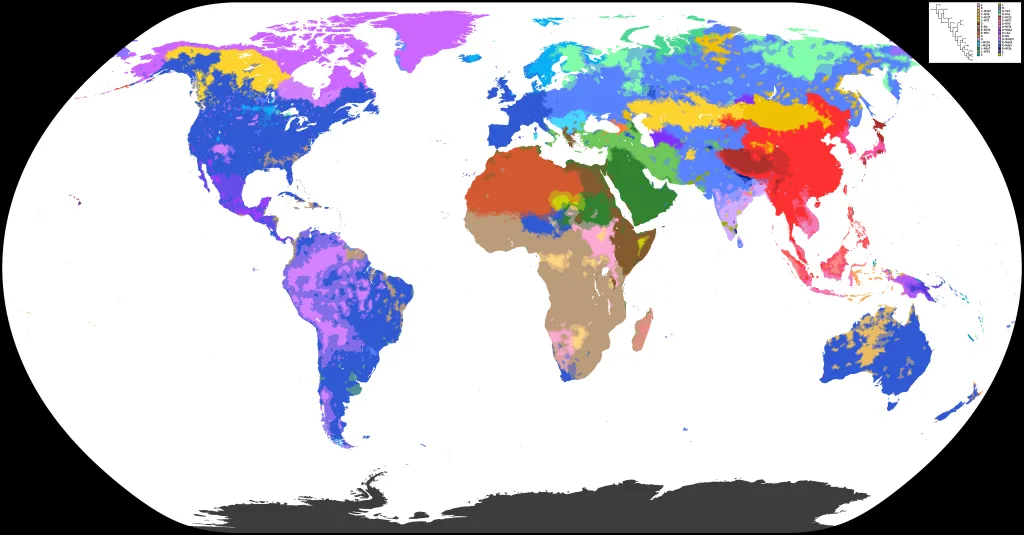
A 2014 study by Tateno et al., titled “Divergence of East Asians and Europeans Estimated Using Male- and Female-Specific Genetic Markers,” affirms that there are three primary genetic groups on earth: African, East Asian, and European. Using the data compiled by Tateno, I have listed the prevailing haplogroups for each major region below.
AFRICA
- E (especially E1bla in West/Central/Southern Africa; E1b1b more in Northeast/North Africa) — by far the most common across the continent.
- A (basal and ancient; highest in certain Southern African groups like Khoisan peoples). A is the most basal (earliest diverging from the root).
- B (also ancient; low frequency except for specific tribes).
EAST ASIA
- O (by far the most common, typically 50-75%+ across much of East Asia).
- N (higher in Northern Asia/Siberia and among some Uralic groups; present in parts of East Asia).
- C (widespread at moderate frequencies, especially in some Northeast Asian or coastal groups).
- D (regionally important in Tibet, Japan, and parts of Southeast Asia/Andaman Islands).
- Q (low but notable frequencies; linked to ancient Siberian connections).
EUROPE
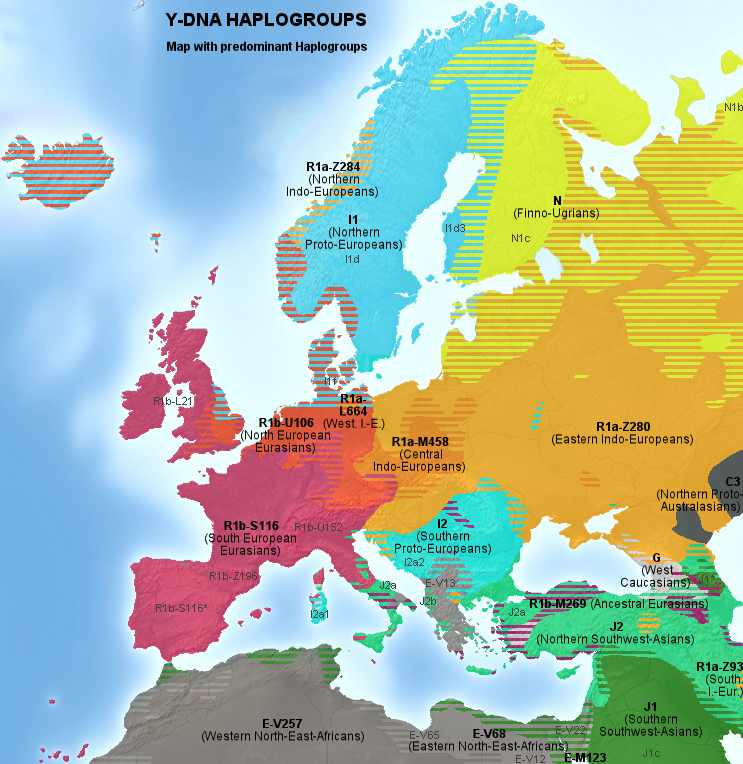
- R (especially R1b in Western Europe, R1a in Eastern Europe — often the single most common overall, frequently 40-80%+ depending on the country).
- I (11 in Northern/Scandinavian Europe; 12 in the Balkans, Sardinia, etc.).
- J (J2 more common in Southern/ Mediterranean Europe; J1 present but lower).
- G (notable in the Caucasus, Southern Europe, and some Alpine areas; generally lower frequency).
For a visual map of the locations of these haplogroups on the Earth, click the image below:
Ham: Father of Africa and Canaan
Scripture is explicit regarding Ham’s descendants:
The sons of Ham were Cush and Mizraim and Put and Canaan.”
Genesis 10:6
Egypt is repeatedly called the “land of Ham” in Scripture (Ps 78:51, 105:23, 106:22), tying it directly to Mizraim’s line. Josephus confirms this, explicitly identifying Mizraim with Egypt and Cush with Ethiopia, noting that “the Ethiopians, over whom he reigned, are even at this day called Chusites” (Antiquities 1.6.2). Likewise, Put is associated with Libya (Jer 46:9), and Canaan with the Levant.
Consistent with Scripture, ancient gravesites across North Africa and the Levant overwhelmingly present Haplogroup E as the dominant paternal line (Solé-Morata et al. 2017). In the lands of Ham, E is by far the most prevalent, representing the Hamitic signature from Egypt and Ethiopia to the Canaanite populations of the Levant (Semino et al. 2004; Cruciani et al. 2004). Therefore we can conclude that the African genetic cluster—carrying predominantly Haplogroups E, A, and B—is the genetic expression of Ham’s descendants (de Filippo et al. 2011).
Japheth: Father of the East, Not the Greeks
The sons of Japheth were Gomer and Magog and Madai and Javan and Tubal and Meshech and Tiras.
Genesis 10:2
Conventional scholarship assigns Javan, son of Japheth, as the ancestor of the Greeks. However, this claim does not withstand scrutiny.
In a remarkable letter recorded by Josephus (Antiquities 12.4.10) and in 1 Maccabees 12:19-23, the Lacedemonian (Spartan) King Areus wrote to Onias, the High Priest in Jerusalem:
We have met with a certain writing, whereby we have discovered that both the Jews and the Lacedemonians are of one stock, and are derived from the kindred of Abraham.”
Flavius Josephus, Ant. 12.4.10
The Maccabees accepted this claim as consistent with their own sacred writings (Ant. 13.5.8, see also Josephus’ footnotes). Furthermore, Lazaridis et al. (2017) and Clemente et al. (2021) confirmed through ancient DNA analysis that 4 out of 5 Bronze Age Greek males carried Haplogroup J—the well-established Abrahamic, Shemite lineage. The Greeks were telling the truth, they are Shemite descendants of Abraham, not Japhethites.
Where then are the descendants of Japheth? The location of Tarshish—son of Javan, son of Japheth—provides the answer. Ships destined for Tarshish were built not on the Mediterranean coast, but at Ezion-geber on the Red Sea (2 Chr 20:36), meaning they sailed south into the Arabian Sea.

These voyages occurred only once every three years (1 Kgs 10:22), far longer than any Mediterranean trip. Most tellingly, the cargo brought back included peacocks and yellow jasper (2 Chr 9:20-21; Eze 10:9)—both indigenous to India and East Asia.
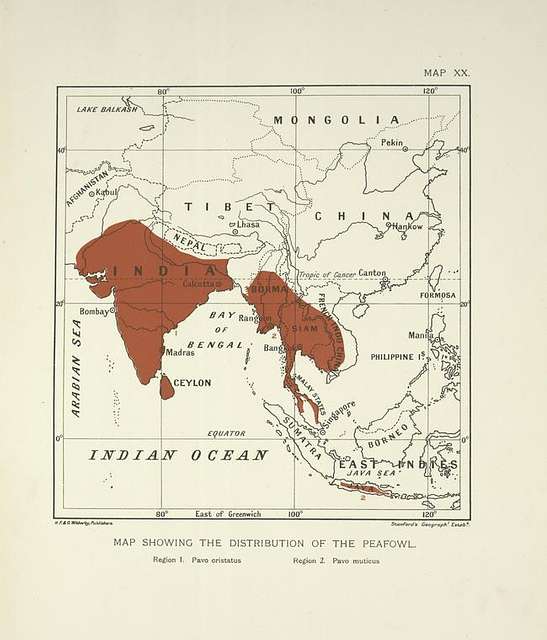
The East Asian genetic cluster, dominated by Haplogroup O (comprising 50–75% of the population across much of East Asia), along with N, C, D, and Q, represents the descendants of Japheth, the “Coastland Peoples” dwelling at the “distant coastlands,” including the Java Sea (Gen 10:5, Isa 66:19, 60:9, Ps 72:10). In fact, the British scholar Thomas Stamford Raffles in his work History of Java, suggested a possible source for the word Java is the Malay word jauh, meaning “beyond” or “distant”–the precise word used to describe the lands of Javan (Isa 66:19).
The sons of Javan: Elishah, Tarshish, Kittim, and Dodanim. From these the Coastland Peoples spread in their lands, each with his own language, by their clans, in their nations.
Genesis 10:4-5
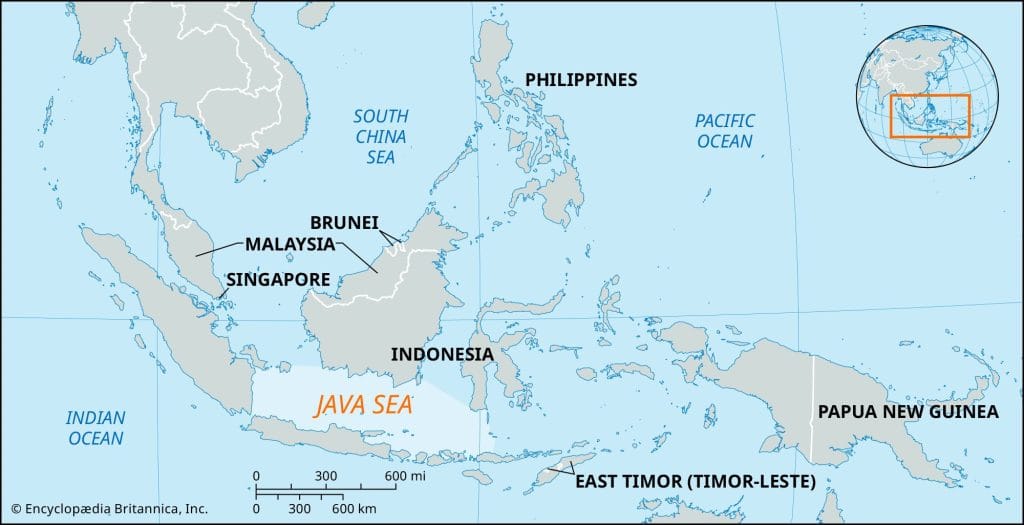
The Java Sea, whose island takes its name from the ancient Sanskrit Yāvadvīpa, bears a striking phonetic resemblance to the Hebrew Yāvān (Javan), son of Japheth. Whether this reflects a genuine genealogical memory embedded in the ancient toponymy, or a parallel linguistic coincidence, the Java Sea sits exactly in the region Scripture designates for the Coastland Peoples of Javan's descendants (Gen 10:4-5).
Shem: Father of the Shemites—Including the Europeans
That leaves the European genetic cluster as Shemitic in origin. This is no doubt a conclusion that surprises many readers but is nevertheless well-supported by both Scripture and science.
Haplogroups G, J, I, and R are all Shemite sibling lines (Semino et al., 2004; Sahakyan et al., 2021). G is predominant in the Caucasus. J dominates the Near and Middle East, carrying the Abrahamic signature. I is found predominantly in Scandinavia and Northern Europe—and critically, J and I are sibling subclades, meaning the Vikings and the Persians share a common Shemite ancestor. While these findings are shocking, Scripture confirms Abraham himself sent his servants north toward Haran (Gen 11:31) to find a wife for Isaac, because his extended kin had already migrated in that direction.
Haplogroup R—the most recent mutation from this Shemite pool and the single most common haplogroup in Europe and Central Asia—is the lineage this article most closely examines. As the most recent and most widespread Shemite branch, R is the prime candidate for the genetic signature of Israel.
We will confirm this extraordinary postulation by employing both Scriptural and empirical evidence in the 8 Criteria for Identifying Israel below.
If one gives an answer before he hears, it is his folly and shame.
Proverbs 18:13
8 Criteria for Identifying Ethnic Israel
The following eight criteria are derived directly from Scripture and tested against the best available genetic, archaeological, and historical evidence. Each criterion must be met simultaneously for a population to be a credible candidate for Ethnic Israel.
Prepare for cognitive dissonance accompanied by a healthy portion of theological discombobulation.
Criterion 1: Israel Must Be “Peculiar” from the Natives of Canaan
“For thou art an holy people unto the Lord thy God, and the Lord hath chosen thee to be a peculiar people unto himself, above all the nations that are upon the earth.”
Deuteronomy 14:2 (see also Ps 135:4, Deut 26:18, Ex 19:5, 1 Pet 2:9, Titus 2:14)
God commanded Israel to remain genetically and culturally distinct from the Canaanites (see Deut 7:1-4, Ex 34:11-16, Josh 23:11-13, Ezra 9–10, Neh 13:23-27). Accordingly, we can expect this “peculiarity” to be scientifically observable in the archaeological record.
And it is.
Haber et al. (2017 & 2020, American Journal of Human Genetics) and Agranat-Tamir et al. (2020, Cell) demonstrate that the Levant was dominated by Haplogroups J and E from the Neolithic through the Bronze Age—these lineages represent the established natives of Canaan. In stark contrast, all individuals carrying Haplogroup R (Samples I2189, I10269, I10359, I10361, I10768, I2062, ASH067—listed in the Mallick et al. 2024 AADR-derived haplotree.info database) are classified by researchers as “outliers.” Their Principal Component Analysis (PCA) position shows a significant shift toward the European-related cluster, entirely unlike the surrounding population.

What makes this finding remarkable is that Strontium Isotope Analysis (SIA) confirms these individuals were born locally in the Levant—yet their genomic signature remained stubbornly distinct across multiple generations. They lived among the Canaanites, were born in Canaan, yet were never assimilated into the Canaanite genetic baseline (see Deut 7:3). In every scientific sense of the word, they were a “peculiar people” science now calls “outliers.”

Furthermore, you shall not intermarry with them; you shall not give your daughters to their sons, nor shall you take their daughters for your sons.
Deuteronomy 7:3
Criterion 2: Israel’s Paternal Lines Must Pulse Into and Exit the Levant
In the ninth year of Hoshea the king of Assyria took Samaria, and carried Israel away into Assyria, and placed them in Halah and in Habor by the river of Gozan, and in the cities of the Medes.”
2 Kings 17:6 (see also 1 Chron 21:5, 2 Kings 25:4-11, Ezra 2:64, Neh 7:66)
Circa 1000 BC, David’s census recorded 1.5 million men in Israel (1 Chron 21:5). After the Assyrian exile (722 BC) and the Babylonian captivity (586 BC), only 40,000 total people (men, women, and children of Israel) returned to Jerusalem (Ezra 2:64, Neh 7:66). The question of where that massive population went is not merely historical curiosity; it is prophetic necessity.
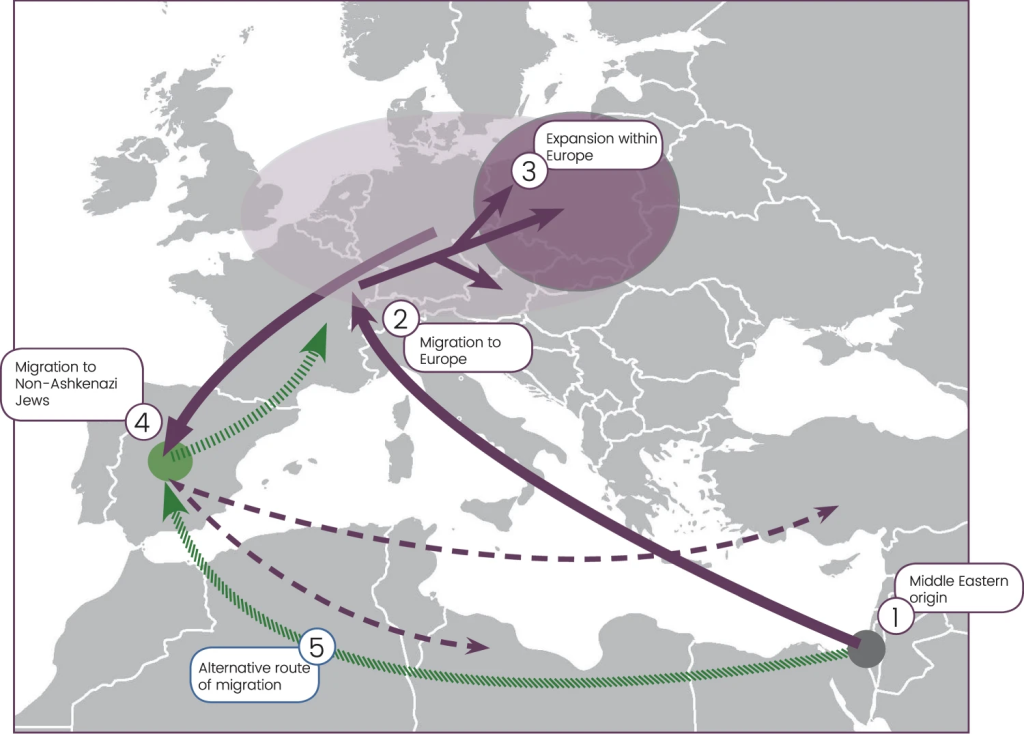
Coinciding with the Biblical records, several modern genetic studies document the sudden appearance of European-related ancestry in the Levant during the Bronze-to-Iron Age transition (c. 1500–1200 BC), appearing at strategic Israelite sites like Megiddo, Tel Shadud, and Ashkelon (Haber et al. 2020; Agranat-Tamir et al. 2020; Feldman et al. 2019; Van den Brink et al. 2017). This Northern-admixed, Haplogroup R signature achieves its population impact at precisely 1,000 BC—the era of the Davidic Kingdom—before diminishing as the Assyrian and Babylonian exiles scatter the population northward (Haber et al. 2020).
"During the Iron Age (~1000 BCE), people with Anatolian and South-East European ancestry admixed with people in the Near East." - Haber et al. 2020

"We found that significant genetic changes that were marked by an increase in Eurasian ancestry related to ancient Europeans and ancient Central Asians occurred after the Bronze Age and starting from the Iron Age II [c. 1000 BC]" - Haber et al. 2020
Feldman et al. (2019) documents that the European-related component significantly fades in urban centers as J/E populations re-establish dominance following the Assyrian & Babylonian exiles. This is exactly what the biblical narrative records: a great ancient population pulses into the Levant (Haplogroup R), flourishes during the Davidic Kingdom, and then exits—leaving only a remnant trace found in modern surveys of Lebanon (Zalloua et al. 2008 & 2012) and Iran (Grugni et al. 2012).
Sidenote: Zalloua et al. 2008 discovered R1b is more prevalent among Lebanese Christians than Lebanese non-Christians, and J(xJ2)/J1 is more prevalent among Lebanese Muslims than Lebanese non-Muslims.
Criterion 3: Israel’s Levites Must Preserve the Ancient Genetic Signature
Thus shalt thou separate the Levites from among the children of Israel: and the Levites shall be mine.”
Numbers 8:14 (see also Num 3:12, 3:45, Ex 2:1, Eze 44:21-22, Ezra 9:1-4, Neh 13:28-29)
The Levites were commanded to remain endogamous—Moses’ parents serve as an excellent example of this practice (Ex 2:1). In addition, the Levites were distributed across all 48 cities of Israel (Num 35, Josh 21) to serve as a priestly thread woven through the entire nation. If Haplogroup R represents Israel, the Levites—as the most rigorously endogamous tribe—should carry a preserved, ancient version of that signature.
They do.
Behar et al. (2003 & 2017) and Rootsi et al. (2013, Nature Communications) confirm that the vast majority of Ashkenazi Levites carry the R1a-M582 subclade, which is virtually absent in non-Levite Near Eastern populations. The modern Levite lineage (R1a-M582) descends directly from R1a-M417—the precise haplogroup of Sample I2189, buried at Megiddo (Agranat-Tamir et al. 2020; Mallick et al. 2024).
When we recalibrate the remains using the 14th-century BC radiocarbon plateau, the Old Wood Effect for surrounding strata (layer of material), and the Levantine Offset (Manning et al. 2018 & 2020), Sample I2189 fits comfortably within the Joshua/Judges period (c. 1350 BC). To further strengthen this recalibration, Sample I2190, found in the same K-10 strata at Megiddo (a city of Manasseh), was directly carbon-dated to 1496–1302 BC without any recalibration required (Table S1, Agranat-Tamir et al. 2020). In other words, there is a direct, unbroken biological line from a body buried in Megiddo during the era of Israel’s Conquest of Canaan (1406-1399 BC) to the Ashkenazi Levites alive today.
There are approximately 300,000 Ashkenazi Levites today — roughly 4% of the total worldwide Jewish population (Behar et al. 2003). Among the Levites, the majority carry Haplogroup R1a-M582, while the broader Ashkenazi population carries predominantly Haplogroups J (~38%) and E (~20%) (Behar et al. 2003; Rootsi et al. 2013).
This distinction matters enormously. Haplogroups J and E have always dominated the Levant — before Israel arrived, during Israel’s occupation, and after the exiles scattered them. They are the genetic baseline of the region. Haplogroup R, by contrast, is the outlier — the misfit whose presence in the Levant continues to perplex secular scholars who have no theological framework to explain it.
But we do.
The Lord declared it plainly: ‘the Levites shall be Mine’ (Num 8:14). True to that promise, the most endogamous tribe in all of Israel has faithfully carried the ancient Haplogroup R signature across three millennia — preserved in the Levites, just as God said it would be.
Overall, five Haplogroup R bodies were found at Megiddo—three R1b (Northwest European) and two R1a (Eurasian). The Ashkenazi Levite ancestor is among them. Moreover, the Levites’ closest living genetic relatives today are found in Iran—precisely where the medieval traveler Benjamin of Tudela (1173 AD) recorded remnants of four Israelite tribes: Dan, Zebulun, Asher, and Naphtali (Itinerary, p. 59, Adler trans., Oxford University Press, 1907).
“…in the mountains of Naisabur four of the tribes of Israel dwell, namely, the tribe of Dan, the tribe of Zebulun, the tribe of Asher, and the tribe of Naphtali, who were included in the first captivity of Shalmaneser, king of Assyria, as it is written (2 Kings xviii. 11)…”
The Itinerary of Benjamin of Tudela. Translated and edited by Marcus Nathan Adler, Oxford University Press, 1907, p. 59.
Criterion 4: The Tomb of the Shroud reveals Israel Must Experience Leprosy and Tuberculosis at the Highest Levels
“The Lord will smite thee with the botch of Egypt, and with the emerods, and with the scab, and with the itch, whereof thou canst not be healed.”
Deuteronomy 28:27 (see also Deut 28:22, Lev 13:2, Num 12:10, 2 Kgs 5:27, 2 Chr 26:19-21, Lev 26:16)
Among the curses pronounced upon a disobedient Israel in Deuteronomy 28 are devastating diseases. If Haplogroup R populations are the descendants of Israel, we can estimate they would carry the historical burden of these diseases at disproportionate rates.
Matheson et al. (2009, PLOS ONE) analyzed the Tomb of the Shroud in Jerusalem (c. 30 AD)—identified as an Israelite burial site—and found both Leprosy (M. leprae) and Tuberculosis (M. tuberculosis) in remains carrying the mtDNA (maternal) Haplogroup H signature. This link suggests that the remnant families of Jerusalem carried these conditions northward with them as the Haplogroup R lineage migrated.
Historical epidemiology confirms that the highest concentrations of both diseases subsequently occurred in R-lineage strongholds of Northern and Western Europe. Medieval Northern and Western Europe became the worldwide epicenter of both leprosy and tuberculosis—precisely the regions dominated by Haplogroup R (Donoghue et al. 2005; Schuenemann et al. 2018; Inskip et al. 2015; Frieden et al. 2003; Rieder 1999; Gagneux 2018).
Furthermore, the mtDNA haplogroups recovered from the Tomb of the Shroud—H, V, T, and W (Tables 3 & 5, Matheson et al. 2009)—each peak today in specific Haplogroup R populations.
- Haplogroup H is highest in Basque Country and Wales (Pereira et al. 2005; Achilli et al. 2004);
- Haplogroup V is highest in Fennoscandia (Torroni et al. 2001);
- Haplogroup T is highest among Eastern Europeans such as the Udmurts (Wilde et al. 2014); and
- Haplogroup W is highest in Finland (Torroni et al. 1996).
The women buried in a first-century Jerusalem tomb genetically point north—to the same nations where Haplogroup R is dominant.

Criterion 5: Israel Must Have High Dairy Tolerance
“But I have said unto you, Ye shall inherit their land, and I will give it unto you to possess it, a land that floweth with milk and honey: I am the Lord your God, which have separated you from other people.”
Leviticus 20:24 (see also Ex 3:8, Num 14:8, Deut 32:14, Song 5:1)
The land promised to Israel was described as flowing with milk and honey—a diet requiring the ability to digest dairy into adulthood. This biological capacity, known as Lactase Persistence, is not universal. It is a specific genetic trait.
Bersaglieri et al. (2004, American Journal of Human Genetics) confirms that the C/T-13910 allele for Lactase Persistence is most prevalent in Northern and Western European populations—predominantly Haplogroup R—often reaching 90–100% tolerance. This is the highest rate of dairy tolerance on Earth (see also Itan et al. 2010).
…He made him suck honey from the rock,
Deuteronomy 32:13-14
And oil from the flinty rock, curds of cows, and milk of the flock…”
In striking contrast, Tishkoff et al. (2007, Nature Genetics) and Storhaug et al. (2017, The Lancet) show that indigenous Near Eastern and African populations have dramatically lower rates of tolerance: Near East ~25%, West Africa ~5–20%, Central Asia ~11–32%, Indigenous Americas ≤5%, East Asia ~1%.
The same population which is commanded to inherit a land flowing with milk is also the population that, uniquely among the nations, can actually drink it.
Criterion 6: Following Dispersion, Israel Must Forget Its Heritage
My people hath been lost sheep: their shepherds have caused them to go astray, they have turned them away on the mountains: they have gone from mountain to hill, they have forgotten their resting place.”
Jeremiah 50:6 (see also Jer 50:5-7, Lam 2:6, Neh 13:24)
One of the most striking and consistent themes in the prophetic literature is that Israel, during the long years of its dispersion, would forget who it was. This is not incidental—it is a divine pronouncement woven through Jeremiah, Lamentations, and Ezekiel alike. In Ezra and Nehemiah, we see a foretaste: after a mere 70 years in Babylon, the returning Israelites had already forgotten their own language, speaking instead the tongues of Moab, Ashdod, and other foreign nations (Neh 13:24).
While the Ashkenazi / Edomite Haplogroups J & E retained a fierce longing to appropriate the lands of Israel (Eze 36:5)—and have never forgotten their claim—the vast majority of the Haplogroup R population in the North completely forgot their ancestral lands (Jer 31:8), fulfilling this specific prophetic curse with remarkable precision. Today, if one were to tell a European possessing Haplogroup R they are an Israelite descendant of Jacob, they would likely laugh. However, the laughter is prophesied to turn to mourning once everyone realizes this (Jeremiah 31:8-9, 50:4-5, Hosea 3:5).
Behold, I am bringing them from the North country,
Jeremiah 31:8-9
And I will gather them from the remote parts of the earth… A great company, they will return here. With weeping they will come…
Although Israel has forgotten its heritage, certain cultural fingerprints remained, embedded in language and law:
- Celtic, spoken across Europe until the 3rd century AD, possesses a precise VSO (Verb-Subject-Object) syntax as well as inflected prepositions—grammatical structures that align with Biblical Hebrew far more closely than with Arabic (The Affinity between the Hebrew Language and Celtic, Dr. Thomas Stratton).


- English Common Law mirrors the Adversarial Law of the Pentateuch—emphasizing community justice (the jury of peers, Deut 19:15) and precedent over the Inquisitorial, state-as-authority approach of Roman Civil Law (see Blackstone’s Commentaries on the Laws of England).
- The Sabbatarian traditions—Saturday or Sunday rest—have persisted throughout the Haplogroup R nations of the North despite forgetting the covenant (Jer 50:5). They forgot the name of what they observed, they rebelled against the command itself, yet a remnant of the Sabbath practice remained.
It is important to note the Celtic Church across Scotland, Ireland, Wales, Cornwall, and Gaul observed Saturday as the Sabbath well into the 11th century, when Queen Margaret of Scotland was required to convene a formal council to abolish it (Turgot, Vita S. Margaritae, Section 20; Moffatt, The Church in Scotland, 1882, p. 140; Lang, A History of Scotland, Vol. 1, p. 96; Skene, Celtic Scotland, Vol. II, pp. 348–350). This Saturday Sabbath tradition, observed long before Roman Catholic influence reached these regions, is consistent with an early Apostolic Christianity distinct from Rome — precisely what Tertullian, Eusebius, and Gildas attest to in Criterion 7.
Prof. James C. Moffatt, D.D., The Church in Scotland (1882), p. 140: "It seems to have been customary in the Celtic churches of early times, in Ireland as well as Scotland, to keep Saturday, the Jewish Sabbath, as a day of rest from labour. They obeyed the fourth commandment literally upon the seventh day of the week."
Criterion 7: Following the Resurrection, Israel Must Be Visited Early by the Apostles
These twelve Jesus sent forth, and commanded them, saying, Go not into the way of the Gentiles, and into any city of the Samaritans enter ye not: But go rather to the Lost Sheep of the House of Israel.”
Matthew 10:5-6 (see also Matt 15:24, James 1:1, 1 Pet 1:1, Gal 2:9)
Jesus gave the original Twelve a specific and startling commandment: bypass the Gentiles, bypass the Samaritans, and go to the Lost Sheep of the House of Israel (a title given Israel in Jeremiah 50:6). This was not merely a directive for the three years of His earthly ministry—it was an apostolic mission to be fulfilled after the Resurrection, when the disciples would finally spread out across the known world.
Paul confirms the division of labor in Galatians 2:7-9: Peter, James, and John were entrusted with the gospel “to the circumcised”—the Lost Sheep—while Paul was called to the Gentiles. James writes his epistle “to the twelve tribes which are scattered abroad” (James 1:1). Peter addresses his first letter to the diaspora scattered throughout Pontus, Galatia, Cappadocia, Asia, and Bithynia (1 Peter 1:1)—all of which are in Anatolia, precisely where Haplogroup R remnants appear in the archaeological record.
Now, the historical record makes a remarkable claim. Tertullian (c. 155–220 AD), writing in Adversus Judaeos (Against the Jews), Chapter 7, Section 4, states in Latin:
“Et Britannorum inaccessa Romanis loca Christo vero subdita”—”The places of the Britons, inaccessible to the Romans, truly subjected to Christ.”
Tertullian, Adversus Judaeos, Chapter 7, Section 4.
The first permanent Roman fortress in Britain was established at Camulodunum (modern Colchester) following the Claudian invasion of AD 43 (Tacitus, Annals XII.32; Colchester Archaeological Trust). To be crystal clear, Tertullian is saying the British Isles had received the gospel before the Romans arrived.
Eusebius (c. 260–340 AD), in Demonstratio Evangelica (Book 3, Chapter 7, pp. 112–113, Ferrar trans.), records that in the first century, the Apostles and earliest disciples “crossed the Ocean and reached the Isles of Britain”—declaring this to be no work of mere men but of Divine Providence.
Gildas (6th-century British monk), in De Excidio et Conquestu Britanniae (Section 8), provides an exact date: the Gospel reached Britain during “the latter part of the reign of Tiberius Caesar”—whose reign ended in AD 37, a mere six years after the Resurrection in 31 AD.
Finally, the Scottish Declaration of Arbroath (1320) states that the Scots journeyed from Greater Scythia—the lands directly north of Assyria—arriving in Scotland “twelve hundred years after the people of Israel crossed the Red Sea.” They were confirmed in the Christian faith, they declare, by none other than Saint Andrew, the Blessed Peter’s brother, the first-called of the Twelve.

Declaration of Arbroath 2020 facsimile
Four independent historical sources—Tertullian, Eusebius, Gildas, and the Declaration of Arbroath—converge on a single, stunning conclusion: the Apostles reached the British Isles, the heartland of Haplogroup R, within a few years of the Resurrection. There is only one reason the Apostles would travel that far, that fast: they were seeking out the Lost Sheep of Israel, exactly as the Lord Jesus had commanded them.
James, a bond-servant of God and of the Lord Jesus Christ, to the Twelve Tribes who are dispersed abroad: Greetings.
James 1:1
Criterion 8: In the Last Days, Israel Must Be Predominantly North and at the Ends of the Earth
“Behold, I will bring them from the North country, and gather them from the farthest parts of the earth, among them the blind and the lame, the pregnant woman and she who is in labor, together; a great company, they shall return here.”
Jeremiah 31:8 (see also Jer 3:12, 3:17-18, 16:14-15, 23:7-8, Zech 2:6, Isa 43:5-6, 49:12, 41:9, Deut 30:4, Isa 11:12, Deut 28:64)
The prophets are unanimous and repetitive on this point: in the Last Days, when God restores Israel to the land of their fathers, He will bring them primarily from the North—and from the very ends of the earth. This is not a single passing reference. It appears in Jeremiah, Zechariah, Isaiah, and Deuteronomy across multiple independent passages.
Jobling & Tyler-Smith (2003 & 2017, Nature Reviews Genetics) and worldwide Y-DNA frequency maps (e.g. Eupedia Y-DNA Frequency; see also Poznik et al. 2016; Karmin et al. 2015) confirm that Haplogroup R is the dominant lineage in precisely the regions described:
- The North: Europe, Russia, Scandinavia, and Central Asia—all north of the Levant—are overwhelmingly Haplogroup R.
- The Ends of the Earth: Australia, New Zealand, South Africa, and South America—the geographic extremities of the inhabited world—are also significantly Haplogroup R, the result of the European colonial migrations of the past five centuries.

This is not forced. The same group—Haplogroup R (R1a & R1b)—is north of the Levant and at the ends of the earth. The statistical probability of this occurring by chance, in exactly the regions designated by multiple independent prophetic texts, is vanishingly small. Moreover, when viewing the “Circle of the Earth” (Isa 40:22) from our Creator’s perspective, such as on the Gleason Standard Map of the World, the “ends of the Earth” where Haplogroup R resides becomes obvious.
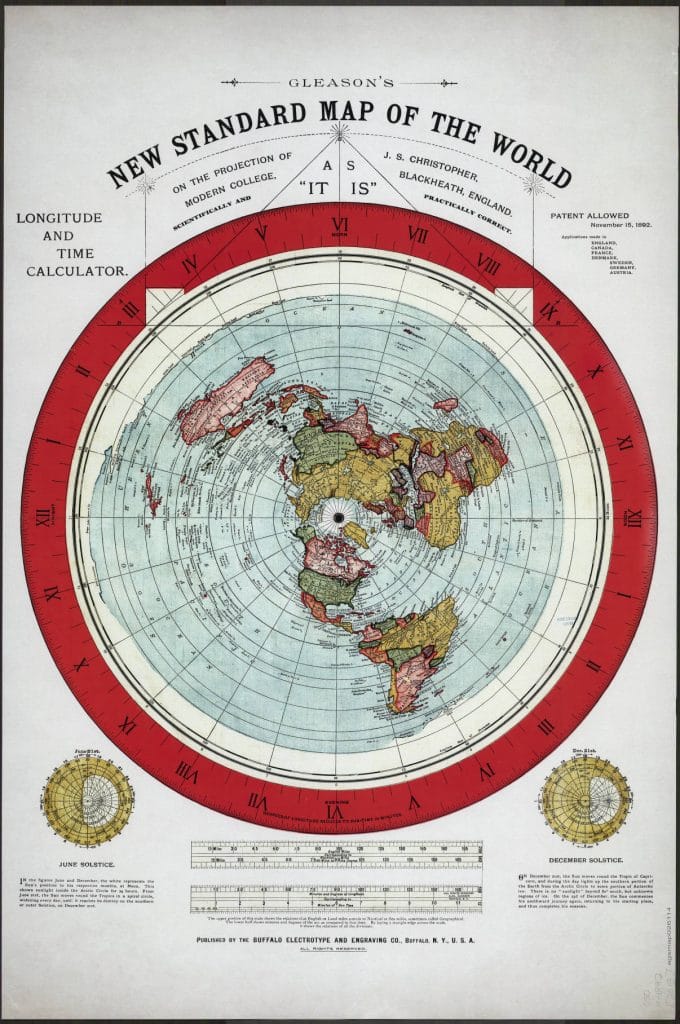
When Jeremiah prophesies “I will bring them from the North country, and gather them from the farthest parts of the earth” (Jer 31:8), he likewise states “a great company” will return to Israel. Considering the 12 Last Days passages regarding Israel’s return home (cited below) all include the North and/or the Ends of the Earth, we can reach the conclusion that the prophetic map and the genetic map align with a precision that, in the words of Eusebius regarding the apostolic mission to Britain, is best explained not as the work of mere men but of Divine Providence.
Therefore, behold, the days are coming, declares the Lord, when it shall no longer be said, ‘As the Lord lives who brought up the people of Israel out of the land of Egypt,’ but ‘As the Lord lives who brought up the people of Israel out of the north country and out of all the countries where he had driven them.’ For I will bring them back to their own land that I gave to their fathers.”
Jeremiah 16:14-15
It is worth noting that Europeans have been uniquely labeled “Colonizers” in modern discourse—almost always as a moral indictment. Nevertheless, the territorial expansion of Haplogroup R populations across the earth can be argued as being precisely what the God of Israel promised to the seed of Jacob: “Every place that the sole of your foot will tread upon I have given you” (Josh 1:3). Likewise, Isaiah 54:3 declares that Israel’s descendants would “dispossess nations and settle in their desolate cities,” and Deuteronomy 33:17 prophesies that the sons of Joseph would push “all peoples to the ends of the earth.” The nations modern culture aggressively labels Colonizers now occupy the very regions Israel was prophesied to inhabit in the Last Days.
Here is a comprehensive list of all passages indicating the Lost Sheep of Israel with return from the North as well as the very edges of the Earth in the Last Days:
| Reference | Direction | Context |
| Jer 3:12 | North explicitly | Call to return |
| Jer 3:18 | North explicitly | End times reunification |
| Jer 16:14-15 | North country | Second Exodus prophecy |
| Jer 23:7-8 | North country | Second Exodus (repeated) |
| Jer 31:8 | North country | Last days regathering |
| Isa 43:5-6 | North included | Four-directional regathering |
| Isa 49:12 | North and west | End times return |
| Isa 11:11-12 | Assyria/north first | Second regathering explicitly |
| Zech 2:6 | North explicitly | Flee from the north |
| Zech 6:6-8 | North country | Spirit rests in the north |
| Deut 30:3-4 | Ends of earth | Scattering and return |
| Deut 28:64 | Ends of earth | Condition of dispersion |
A Final Observation: The Twelve European Genetic Pools
We conclude our argument with a finding that is, frankly, difficult to dismiss even for the most skeptical.
Lazaridis et al. (2015), “Ancient human genomes suggest three ancestral populations for present-day Europeans” (Nature, PMC4170574), conducted a Principal Component Analysis (PCA) of modern West Eurasian populations. The chart produced by this study reveals something extraordinary.

Within the European cluster, twelve genetically distinct but closely related populations emerge, their autosomal DNA clustering tightly together and distinctly apart from all other Shemite populations on the chart:
- East Slavic — R1a (~55%) / I2 (~15%)
- Baltic — R1a (~40%) / N1c (~40%)
- Central European — R1a (~34%) / R1b (~25%)
- Germanic — R1b (~45%) / I1 (~25%)
- Balkan — I2a (~40%) / R1a (~20%)
- Italian — R1b (~35%) / J2 (~18%)
- French — R1b (~58%) / I1 (~9%)
- Spanish — R1b (~65%) / J2 (~10%)
- South French — R1b (~50%) / J2 (~12%)
- Basque — R1b (~85%) / I2 (~6%)
- Sardinian — I2 (~40%) / R1b (~19%)
- Sicilian — R1b (~30%) / J2 (~18%)
10 of the 12 pools have R as their single highest Y-DNA haplogroup. The only exceptions are the Balkans (I2a dominant, R1a second) and Sardinia (I2 dominant, R1b second). Critically, both I2 and R remain Shemite sibling lines (Semino et al. 2004), the R’s moved into the established I’s territory. Although Haplogroup R is not always the single highest haplogroup in every one of these twelve pools, the autosomal DNA of all twelve is closely shared and mutually distinct from the wider Shemite world (Lazaridis et al. 2015). This means these populations have not merely inherited a common paternal line; they share a common total genetic heritage, the accumulated DNA of thousands of years of living together as a people.
Now observe where the Ashkenazi and Sephardi Jewish populations appear on the same chart: outside the European circle, positioned between the European cluster and the Levantine populations (North Levantine, South Levantine, Arabian). This is the genetic signature of a population that is neither European nor fully Levantine—a mixed ancestry consistent with the Edomite Hypothesis, wherein Esau’s descendants intermarried with Canaanite women and an Ishmaelite (Gen 36:2-3), later mixing further with the populations of the ancient Near East. They are Shemitic in origin, as J is a Shemite haplogroup, but they are not Israel as Jesus warned (Rev 3:9).
Behold, I will cause those of the synagogue of Satan, who say that they are Jews and are not, but lie—I will make them come and bow down at your feet, and make them know that I have loved you.
Revelation 3:9
The Ashkenazi cluster sits precisely where we would expect the Edomite converts to Judaism to sit: adjacent to Israel but not among them, adjacent to the Levant but not of it—the exact proximity Edom (Idumea) was to Israel throughout ancient history.

The remaining clusters on the chart—Caucasian, Iranian, Turkish, Mizrahi Jewish, North and South Levantine, Arabian—represent the broader Shemite world of the Middle East and Caucasus: the descendants of Abraham’s many sons, the nations that surround Israel’s ancestral land but are not of Jacob’s line.
And He took him outside and said, “Now look toward the heavens, and count the stars, if you are able to count them.” And He said to him, “So shall your descendants be.” 6 Then he believed in the Lord; and He reckoned it to him as righteousness.
Genesis 15:5-6
Could these twelve European genetic pools be a visualization of the twelve tribes of Israel—scattered, separated by centuries of migration and history, yet retaining enough shared ancestry to cluster together on a modern genetic chart, distinct from every other people group on earth?
Yes.
The probability that this is all coincidence diminishes with every genetic study, every site excavated, every criterion examined.
Europeans are the Israelites of the Bible. The rattling has begun (Eze 37:7).
…as I prophesied, there was a noise, and behold, a rattling; and the bones came together…”
Ezekiel 37:7
An Invitation to Research
This article remains a hypothesis—a proposed explanation made on the basis of mounting evidence that demands serious investigation. Likewise, I am not asserting that every European is a child of God by virtue of their ancestry (even in Scripture many Israelites served the Devil, see Rom 9:6), nor that God’s redemptive purposes are limited to any ethnic group. Christ’s blood was shed for all of humanity, and His invitation is open to every tongue, tribe, and nation.
After this I looked, and behold, a great multitude that no one could number, from every nation, from all tribes and peoples and languages, standing before the throne and before the Lamb, clothed in white robes, with palm branches in their hands,
Revelation 7:9
What I am asserting is that the prophetic scriptures describe a specific ethnic group with specific characteristics—and that modern genetic science, ancient archaeology, early Church history, and comparative linguistics are converging on a single candidate: the Haplogroup R populations of Europe and their diaspora.
The dry bones of Ezekiel 37 are beginning to rattle.
If you are a scholar, researcher, geneticist, historian, or theologian who finds these arguments compelling—or who believes they can be improved, challenged, or extended—I want to hear from you. The goal of this project is the pursuit of Truth. Every serious objection sharpens the hypothesis. Every new grave site, every additional historical record, every genetic study brings us closer to an answer that has enormous implications for our understanding of Last Days prophecy.
The Lost Sheep are not lost forever. The Good Shepherd knows exactly where they are, and He will bring them home.
Veritas Christo et ecclesiae.
“Behold, I will bring them from the North country and gather them from the farthest parts of the earth”
Jeremiah 31:8
Citation Reference List
The following links provide free public access to the primary sources cited in this article. Where a PMC (PubMed Central) link is available, it provides the full peer-reviewed text.
Peer-Reviewed Genetic Studies
Poznik et al. (2013) — Sequencing Y Chromosomes Resolves Discrepancy in Time to Common Ancestor of Males Versus Females, Science https://pmc.ncbi.nlm.nih.gov/articles/PMC4032117/
Tateno et al. (2014) — Divergence of East Asians and Europeans Estimated Using Male- and Female-Specific Genetic Markers, Genome Biology and Evolution https://pmc.ncbi.nlm.nih.gov/articles/PMC3971580/
Solé-Morata et al. (2017) — Whole Y-chromosome sequences reveal an extremely recent origin of the most common North African paternal lineage E-M183 (M81), Scientific Reports https://www.nature.com/articles/s41598-017-16271-y
Semino et al. (2004) — Origin, Diffusion, and Differentiation of Y-Chromosome Haplogroups E and J, American Journal of Human Genetics https://www.cell.com/ajhg/fulltext/S0002-9297(07)64366-3
Cruciani et al. (2004) — Phylogeographic Analysis of Haplogroup E3b (E-M215) Y Chromosomes Reveals Multiple Migratory Events Within and Out Of Africa, American Journal of Human Geneticshttps://pmc.ncbi.nlm.nih.gov/articles/PMC1181964/
de Filippo et al. (2011) — Y-Chromosomal Variation in Sub-Saharan Africa: Insights into the History of Niger-Congo Groups, Molecular Biology and Evolution PubMed: https://pubmed.ncbi.nlm.nih.gov/21109585/ Full text (Oxford Academic): https://academic.oup.com/mbe/article/28/3/1255/994848
Lazaridis et al. (2015) — Ancient Human Genomes Suggest Three Ancestral Populations for Present-Day Europeans, Nature (source of PCA chart) https://pmc.ncbi.nlm.nih.gov/articles/PMC4170574/
Lazaridis et al. (2017) — Genetic Origins of the Minoans and Mycenaeans, Naturehttps://www.nature.com/articles/nature23310
Clemente et al. (2021) — The Genomic History of the Aegean Palatial Civilizations, Cell https://www.sciencedirect.com/science/article/pii/S0092867421003706
Haber et al. (2017) — Continuity and Admixture in the Last Five Millennia of Levantine History, American Journal of Human Genetics https://pmc.ncbi.nlm.nih.gov/articles/PMC5544389/
Haber et al. (2020) — A Genetic History of the Near East from an aDNA Time Course Sampling Eight Points in the Past 4,000 Years, American Journal of Human Genetics https://pmc.ncbi.nlm.nih.gov/articles/PMC7332655/
Agranat-Tamir et al. (2020) — The Genomic History of the Bronze Age Southern Levant, Cellhttps://pmc.ncbi.nlm.nih.gov/articles/PMC10212583/ Direct Cell link: https://www.cell.com/cell/fulltext/S0092-8674(20)30487-6
Feldman et al. (2019) — Ancient DNA Sheds Light on the Origins of the Philistines, Science Advances https://www.science.org/doi/10.1126/sciadv.aax0061
Van den Brink et al. (2017) — A Bronze Age Burial at Tel Shadud, Journal of the Israel Prehistoric Society https://reich.hms.harvard.edu/sites/reich.hms.harvard.edu/files/inline-files/2017_VanDenBrink_Levant_TelShadud_0.pdf
Mallick et al. (2024) — The Allen Ancient DNA Resource (AADR) https://www.nature.com/articles/s41597-024-03031-7
Rootsi et al. (2013) — Phylogenetic Applications of Whole Y-Chromosome Sequences and the Near Eastern Origin of Ashkenazi Levites, Nature Communications https://www.nature.com/articles/ncomms3928
Behar et al. (2003) — Multiple Origins of Ashkenazi Levites: Y Chromosome Evidence for Both Near Eastern and European Ancestries, American Journal of Human Genetics https://pmc.ncbi.nlm.nih.gov/articles/PMC1180600/
Behar et al. (2017) — The Genetic Variation in the R1a Clade Among the Ashkenazi Levites’ Y Chromosome, Scientific Reports https://pmc.ncbi.nlm.nih.gov/articles/PMC5668307/
Manning et al. (2018) — Fluctuating Radiocarbon Offsets Observed in the Southern Levant and Implications for Archaeological Chronology Debates, PNAS:https://www.pnas.org/doi/10.1073/pnas.1719420115
Manning et al. (2020) — Radiocarbon Offsets and Old World Chronology as Relevant to Mesopotamia, Egypt, Anatolia and Thera (Santorini), Scientific Reports:https://www.nature.com/articles/s41598-020-69287-2 PMC version: https://pmc.ncbi.nlm.nih.gov/articles/PMC7431540/
Matheson et al. (2009) — Molecular Exploration of the First-Century Tomb of the Shroud in Akeldama, Jerusalem, PLOS ONE https://journals.plos.org/plosone/article?id=10.1371/journal.pone.0008319
Donoghue et al. (2005) — Co-infection of M. tuberculosis and M. leprae in Human Archaeological Samples, Proceedings of the Royal Society B: Biological Sciences https://pmc.ncbi.nlm.nih.gov/articles/PMC1634979/
Bersaglieri et al. (2004) — Genetic Signatures of Strong Recent Positive Selection at the Lactase Gene, American Journal of Human Genetics https://pmc.ncbi.nlm.nih.gov/articles/PMC1182075/
Itan et al. (2010) — A Worldwide Correlation of Lactase Persistence Phenotype and Genotypes, BMC Evolutionary Biology https://pmc.ncbi.nlm.nih.gov/articles/PMC2834688/
Tishkoff et al. (2007) — Convergent Adaptation of Human Lactase Persistence in Africa and Europe, Nature Geneticshttps://pmc.ncbi.nlm.nih.gov/articles/PMC2672153/
Zalloua et al. (2008) — Y-Chromosomal Diversity in Lebanon Is Structured by Recent Historical Events, American Journal of Human Genetics https://pmc.ncbi.nlm.nih.gov/articles/PMC2427286/
Grugni et al. (2012) — Ancient Migratory Events in the Middle East, PLOS ONE https://journals.plos.org/plosone/article?id=10.1371/journal.pone.0041252
Jobling & Tyler-Smith (2017) — Human Y-Chromosome Variation in the Genome-Sequencing Era, Nature Reviews Genetics https://www.nature.com/articles/nrg.2017.36
Poznik et al. (2016) — Punctuated Bursts in Human Male Demography Inferred from 1,244 Worldwide Y-Chromosome Sequences, Nature Genetics https://pmc.ncbi.nlm.nih.gov/articles/PMC4884158/
Karmin et al. (2015) — A Recent Bottleneck of Y Chromosome Diversity Coincides with a Global Change in Culture, Genome Research https://pmc.ncbi.nlm.nih.gov/articles/PMC4381518/
Historical Primary Sources
Josephus — Antiquities of the Jews (all books, Whiston translation) https://sacred-texts.com/jud/josephus/index.htm#aoj
Josephus — Antiquities Book 12 (for Ant. 12.4.10, Spartan/Maccabean letter) https://penelope.uchicago.edu/josephus/ant-12.html#:~:text=Areus%2C%20King%20of,in%20his%20claws.
Josephus — Antiquities Book 13 (for Ant. 13.5.8, Spartan/Maccabean response) https://penelope.uchicago.edu/josephus/ant-13.html
Tertullian — Adversus Judaeos (Against the Jews) https://www.newadvent.org/fathers/0308.htm
Eusebius — Demonstratio Evangelica (Proof of the Gospel), Ferrar trans., Book 3https://www.tertullian.org/fathers/eusebius_de_05_book3.htm Full digitized text (HathiTrust/Yale): https://babel.hathitrust.org/cgi/pt?id=yale.39002043869495
Gildas — De Excidio et Conquestu Britanniae (On the Ruin of Britain) https://www.gutenberg.org/ebooks/1949
The Declaration of Arbroath (1320) — Yale Avalon Project https://avalon.law.yale.edu/medieval/arbroath_1320.asp
Benjamin of Tudela — The Itinerary, Adler trans., Oxford University Press (1907) https://www.gutenberg.org/files/14981/14981-h/14981-h.htm#:~:text=Gozan.-,And%20there%20are%20men,cities%20of%20the%20Medes,-[166
Turgot of Durham — Vita S. Margaritae (Life of St. Margaret) https://archive.org/details/lifeofstmargaret00turguoft
Raffles, Thomas S. — History of Java, Oxford University Press, 1965https://archive.org/details/historyofjava01raff/page/n5/mode/2up
Secondary Historical Sources (Criterion 6 — Celtic Sabbath)
Prof. James C. Moffatt, D.D. — The Church in Scotland (1882), p. 140 Referenced in: https://www.friendsofsabbath.org/G&S/www.giveshare.org/churchhistory/sabbathscotland.html
Prof. Andrew Lang — A History of Scotland from the Roman Occupation, Vol. 1, p. 96 (1900) Referenced in: https://www.friendsofsabbath.org/G&S/www.giveshare.org/churchhistory/sabbathscotland.html
W.F. Skene — Celtic Scotland, Vol. II, pp. 348–350 (1877) Referenced in: https://en.wikipedia.org/wiki/Saint_Margaret_of_Scotland
Dr. Bryan W. Ball — The Seventh-Day Men: Sabbatarians and Sabbatarianism in England and Wales, 1600–1800(1994, 2nd ed. 2009) https://www.jamesclarke.co/product/seventh-day-men-the-sabbatarians-and-sabbatarianism-in-england-and-wales-1600-1800/
Linguistic & Legal Sources (Criterion 6)
Dr. Thomas Stratton — The Affinity between the Hebrew Language and Celtichttps://dn720209.ca.archive.org/0/items/affinitybetweenh00stra/affinitybetweenh00stra.pdf
Sir William Blackstone — Commentaries on the Laws of England (1765–1769)https://avalon.law.yale.edu/subject_menus/blackstone.asp



Wow – Rich – Thank you for your great work – what an effort …
so great Information to read – YOU SHOULD WRITE A BOOK ON THIS and MORE ….
absolute great Visualisation and graphics etc.
Everybody should read this and make his own thaughts about …
very good Hypothesis – and so very well researched and prepared, staged – more than WELL DONE …. Thank you … hope to read once – a real book from you an all these Topics you discuss …. THANKS – A-MEN
All glory to God! I am thrilled you enjoyed the study and are being edified by the Holy Spirit! In time, many will come to realize these truths, and one day the whole world will know. What an honor for the Spirit to reveal it to us now. May the Lord Jesus bless you!
“Jesus answered them, “To you it has been granted to know the mysteries of the kingdom of heaven, but to them it has not been granted.” – Matt 13:11
Beautifully written! I thank THE LORD for directing me to ur article, well researched & presented. A true disciple.
So glad you’re being edified by the Spirit! Thank you for your encouragement, God bless you!
Great article. Thank you.
Our family has been studying this topic for many years.
A couple of passages I find very relevant also regarding Esau.
Isaac’s blessing of Esau, regarding throwing off the shackles in the latter days is interesting given the USA’s “special ally” status.
Gen 27:38 And Esau said unto his father, Hast thou but one blessing, my father? bless me, even me also, O my father. And Esau lifted up his voice, and wept.
Gen 27:39 And Isaac his father answered and said unto him, Behold, thy dwelling shall be the fatness of the earth, and of the dew of heaven from above;
Gen 27:40 And by thy sword shalt thou live, and shalt serve thy brother; and it shall come to pass when thou shalt have the dominion, that thou shalt break his yoke from off thy neck.
Then also one relevant to the current occupation of the land:
Eze 11:14 Again the word of the LORD came unto me, saying,
Eze 11:15 Son of man, thy brethren, even thy brethren, the men of thy kindred, and all the house of Israel wholly, are they unto whom the inhabitants of Jerusalem have said, Get you far from the LORD: unto us is this land given in possession.
Eze 11:16 Therefore say, Thus saith the Lord GOD; Although I have cast them far off among the heathen, and although I have scattered them among the countries, yet will I be to them as a little sanctuary in the countries where they shall come.
Eze 11:17 Therefore say, Thus saith the Lord GOD; I will even gather you from the people, and assemble you out of the countries where ye have been scattered, and I will give you the land of Israel.
The latter particularly relevant given British mandate over Palestine at end of WW1.
Thanks again.
This is excellent, thank you for pointing that out! The Edomites, Ishmaelites, and Canaanite populations have certainly declared the Lands of Jacob as their own, a fulfillment of Eze 11:15 as you noted. He will bring Israel home (Eze 11:17)!
I suspect the Germanic genetic cluster, which includes Britain, is Judah. This is why Edom ./ Rothschild family needed permission from them. I don’t have conclusive proof they’re Judah yet but I am investigating.
May the Lord Jesus bless you!
Wow, this is mind-blowing! Fantastic work! I realized the haplogroup R were/are all predominantly Christian countries and nations: Europe, USA, Australia, Russia…coincidence? It’s almost as if our genes remember Jesus and our Father God. One could now go into other rabbit holes about why something gene-altering was pushed heavily onto people in 2020/2021. Maybe they knew something that we did not at the time?
All glory to God! I am so glad you’re being edified by the Holy Spirit!
Zalloua et al. (2008) found that R1b is more prevalent among Lebanese Christians than Lebanese non-Christians, while J1 is more prevalent among Lebanese Muslims. Science reveals the population most likely to respond to the Gospel is the Haplogroup R remnant. “My sheep hear My voice” (John 10:27).
May the Lord Jesus bless you!